Pureleven journal
Cooking & Spices
From Kerala soil to your kitchen.
Kerala pepper guide
Kerala Black Pepper: A Buyer's Guide
Move from comparison content into bold, kitchen-ready Kerala pepper with a cleaner buying path.
Quick Summary
How to buy good Kerala black pepper: where it grows, what grades like MG1 and TGEB mean, and simple checks to judge a pack at home.
Jump through the guide
Go straight to the sections that answer the buying, comparison, or sourcing question you came for.
Good Kerala black pepper is heavy, dark, wrinkled and sharply aromatic when you crack a corn. Buy it whole, from a seller who names the district it grew in, and grind small amounts at home. Below is where Kerala pepper comes from, what the grade names mean, and how to check a pack before and after you buy.
We farm and pack spices in Rajakumari, Idukki, where pepper vines climb the shade trees on the same farms as our cardamom. A fair bit of this is what growers here look at when they judge pepper.
What makes Kerala black pepper different?
Black pepper (kurumulak in Malayalam) is a vine native to the Western Ghats, and wild pepper still grows in forest patches along these hills. The Malabar Coast traded it with Roman and Arab merchants for centuries.
Today most of the world's pepper comes from elsewhere. Vietnam is the largest producer, with Brazil, Indonesia and India behind it. So why do cooks still ask for Kerala pepper by name?
- Growing conditions. Heavy monsoon rain, shaded hill slopes and cool nights in districts like Idukki and Wayanad suit the vine.
- Mixed farms. A lot of Kerala pepper grows on small holdings, trained up shade trees among cardamom, coffee or areca.
- A protected name. "Malabar Pepper" is registered as a Geographical Indication in India, covering pepper from the Malabar region.
None of this guarantees a particular pack is good. It means the raw material starts from a strong place.
Malabar, Tellicherry and the other names on a pack
Both names come from the same region. Tellicherry grades are the larger berries sorted out of the crop, and Malabar grades cover the regular sizes. Our comparison of Malabar vs Tellicherry black pepper has the detail.
Karimunda and Panniyur are variety names. They describe the vine, not the grade. See Kerala black pepper varieties for the common ones.
How is Kerala black pepper graded?
Traders look at berry size, how heavy the berries are for their volume, and how clean the lot is. These are the grade names you'll meet most often.
| Grade | What it means | Rough guide |
|---|---|---|
| TGSEB (Tellicherry Garbled Special Extra Bold) | The largest sorted berries | Around 4.75 mm and above |
| TGEB (Tellicherry Garbled Extra Bold) | Large sorted berries | Around 4.25 mm and above |
| MG1 (Malabar Garbled grade 1) | Cleaned regular pepper with few light berries | Strict limits on light berries and dirt |
| Ungarbled / FAQ | Cleaned less strictly, more mixed sizes | More light and broken berries |
"Garbled" means cleaned and sorted. Light berries are hollow, immature corns that add weight to a sack but very little flavour. Specifications differ between standards and buyers, so read the figures as a guide.
For home cooking, size matters less than people think. A fresh, dense MG1-type pepper often beats a big berry that sat in a warehouse for two years.
What should you check before you buy?
- Whole, not powder. Ground pepper loses its smell within weeks, and whole corns keep for many months.
- A named origin. Kerala is good. A district like Idukki or Wayanad is better.
- Dark and wrinkled. Dark brown to black. A greyish, dusty coat points to old stock or poor cleaning.
- Few pinheads and stalks. Some are normal. A lot of tiny corns, stems and dust are not.
- A pack you'll finish. Buy for a few months, then buy again.
How can you tell if pepper is good once it arrives?
- Crack one corn between your teeth. Good pepper bites quickly, then gives a woody, slightly citrus smell. Flat, dusty or musty means old or damp storage.
- Press a corn with your thumbnail. It should feel hard. Hollow corns crush easily.
- Drop a spoonful in water. A few floaters are normal. Many floaters mean many light berries.
- Grind a little. Fresh pepper smells strongly the moment it's cracked.
When is pepper harvested in Kerala?
Harvest runs roughly from December into the first months of the year. It tends to be earlier on lower ground and later in high-range areas like Idukki, depending on the season.
Black or white?
Both come from the same vine. Black pepper is picked just before full ripeness and dried with the skin on. White pepper comes from riper berries with the skin removed, so it has less of the fresh aroma and a cleaner, earthier heat. Our white pepper guide says when to use it.
How should you store whole peppercorns?
Pepper takes up moisture from the air, and light slowly breaks down piperine, the compound behind its heat. Use an airtight glass or steel jar, away from the stove and out of the sun, and grind only what you need. More in how to store spices.
Where ours comes from
Our Kerala black pepper is whole peppercorns from Idukki farms where the vines grow up shade trees alongside cardamom. We pack it whole with nothing added, in resealable pouches, and answer questions on WhatsApp at +91 88482 65849 before you order.
If you have a pepper question this guide skipped, send it over.
Sources
Ready to buy?
Related products for this article
Move from reading intent to shopping intent with product cards tied to this topic and a direct route into the wider catalog.
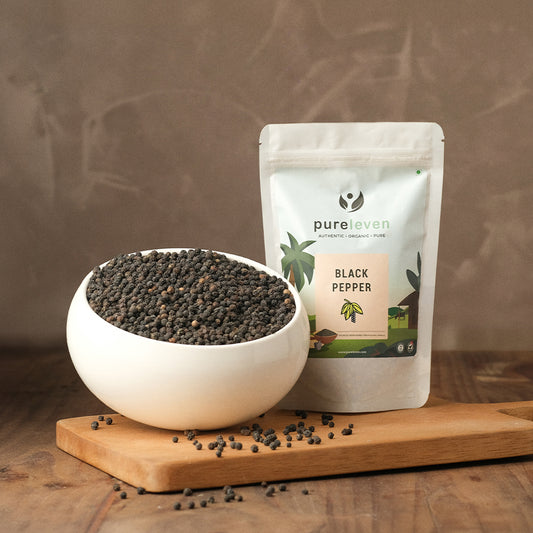 Primary pickKerala Black Pepper (Kali Mirch) – Bold Whole Peppercorns from IdukkiWhole Kerala peppercorns with high aroma and a straightforward upgrade from generic supermarket stock.Rs. 100.00
Also considerKerala Black Pepper (Kali Mirch) – Bold Whole Peppercorns from IdukkiRs. 100.00
Primary pickKerala Black Pepper (Kali Mirch) – Bold Whole Peppercorns from IdukkiWhole Kerala peppercorns with high aroma and a straightforward upgrade from generic supermarket stock.Rs. 100.00
Also considerKerala Black Pepper (Kali Mirch) – Bold Whole Peppercorns from IdukkiRs. 100.00
 Kitchen add-onKerala White Pepper Whole PeppercornsRs. 184.50Rs. 150.00