



Pureleven journal
Cooking & Spices
From Kerala soil to your kitchen.
Pureleven spice journal
Whole Spices List for an Indian Kitchen, and What to Buy First
Answer-first guidance with a faster path to farm-origin Kerala products you can buy today.
Quick Summary
The six whole spices to buy first for a new or small Indian kitchen, plus a full reference list of whole spices with their taste, uses and when to add each one to your shelf.
Jump through the guide
Go straight to the sections that answer the buying, comparison, or sourcing question you came for.
A well-stocked Indian kitchen uses around 15 to 20 whole spices, but six cover most everyday cooking: cumin, mustard seeds, black pepper, green cardamom, cloves and cinnamon. Start with those, then add fennel, fenugreek, coriander seeds, bay leaf and others as you cook more regional dishes.
The starter set: the first six whole spices to buy
If you're setting up a new or small kitchen, these six handle dal, sabzi, rice, chai, biryani and most curries between them.
| Spice | Why it's in the first six | First dishes to use it in |
|---|---|---|
| Cumin seeds (jeera) | The base of most North Indian tadkas | Dal, jeera rice, potato sabzi |
| Mustard seeds (kaduku) | The base of most South Indian tempering | Sambar, thoran, lemon rice, pickles |
| Black pepper (kurumulak) | Heat and aroma in almost any dish | Rasam, pepper chicken, eggs, soups |
| Green cardamom (elakka) | Covers both sweet and savoury | Chai, payasam, biryani |
| Cloves (grampoo) | Depth in rice and meat dishes; a little goes far | Biryani, pulao, meat curries |
| Cinnamon or cassia (karuvapatta) | Warm sweetness for rice, curries and desserts | Pulao, chicken curry, garam masala |
Small packs are enough. A 50 g pack of cloves or cardamom lasts a small household a long time, and whole spices keep their flavour far longer than powders. Our guide on how long whole spices last has the details.
Dried red chillies and coriander seeds are close behind. Many cooks would put them in the first six instead of cardamom or cloves, especially if they cook mostly South Indian vegetarian food.
The full list of whole spices for an Indian kitchen
| Spice | Taste | Used in | Add it when |
|---|---|---|---|
| Coriander seeds | Citrusy, mild | Sambar powder, most masalas | You grind your own masala |
| Dried red chillies | Hot, smoky | Tempering, chutneys, podis | Straight away for South Indian food |
| Fennel seeds (perumjeerakam) | Sweet, anise-like | Kerala meat curries, mouth freshener | You cook Kerala or Malabar dishes |
| Fenugreek seeds (uluva) | Bitter, maple-like | Sambar, fish curry, pickles | You make sambar or fish curry |
| Bay leaf (tej patta) | Herbal, subtle | Biryani, pulao, rajma | You cook rice dishes often |
| Star anise (chakra phool) | Strong, liquorice-like | Biryani, garam masala | You make biryani or your own garam masala |
| Black cardamom (badi elaichi) | Smoky, earthy | North Indian curries, biryani | You cook Punjabi or Mughlai dishes |
| Carom seeds (ajwain) | Thyme-like, sharp | Parathas, pakoras, puris | You fry snacks or make parathas |
| Nigella (kalonji) | Oniony, slightly bitter | Naan, pickles, Bengali dishes | You cook Bengali food or bake naan |
| Nutmeg and mace (jathikka, jathipathri) | Warm, sweet | Garam masala, sweets, biryani | You bake or make festive dishes |
| White pepper | Earthy heat | Stews, soups, white sauces | You make Kerala stew or light-coloured dishes |
| Stone flower (kalpasi) | Earthy, woody | Chettinad masalas | You cook Chettinad food |
For the Malayalam names of these and other spices, see our spice names in Malayalam and English.
How to build your collection by cuisine
- Kerala cooking: after the first six, add fennel, fenugreek, dried red chillies and coriander seeds early.
- North Indian cooking: add bay leaf, black cardamom, ajwain and coriander seeds.
- Bengali cooking: add nigella, fenugreek and fennel for panch phoron.
- Mostly baking and sweets: green cardamom, cinnamon, nutmeg and cloves cover most recipes.
Most of these go into hot oil at the start of cooking. Our guide to tempering whole spices explains the order and timing so nothing burns.
Common mistakes when stocking up
- Buying big packs of rarely used spices. Buy 50 g or less of anything you use once a month.
- Buying ground versions of everything. Powders fade in months. Keep spices whole and grind small amounts.
- Storing jars next to the stove. Heat and steam dull them fast. A closed cupboard away from the hob is better.
- Not labelling. Fennel and cumin, or ajwain and nigella, are easy to mix up in unmarked jars. Add the month you opened each one.
Three of the starter six, cardamom, black pepper and cloves, come from Idukki in our Kerala spice combo, packed whole with nothing added in resealable pouches. It's an easy way to cover half the starter set in one order.
Ready to buy?
Related products for this article
Move from reading intent to shopping intent with product cards tied to this topic and a direct route into the wider catalog.
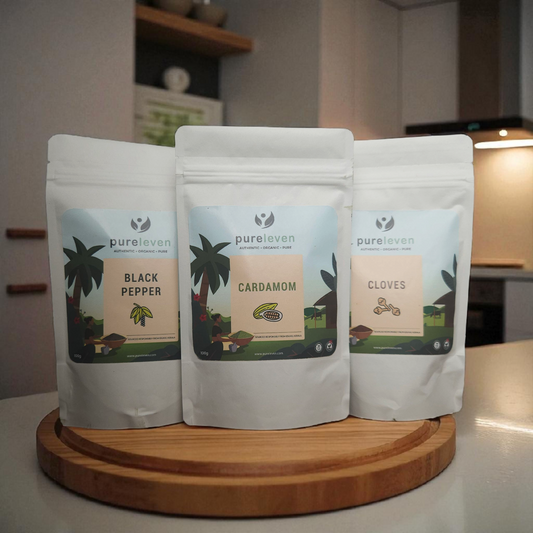 Primary pick3-in-1 Kerala Spice ComboStart with a best-selling Pureleven product picked to match the buying intent behind this article.Rs. 909.00Rs. 559.00
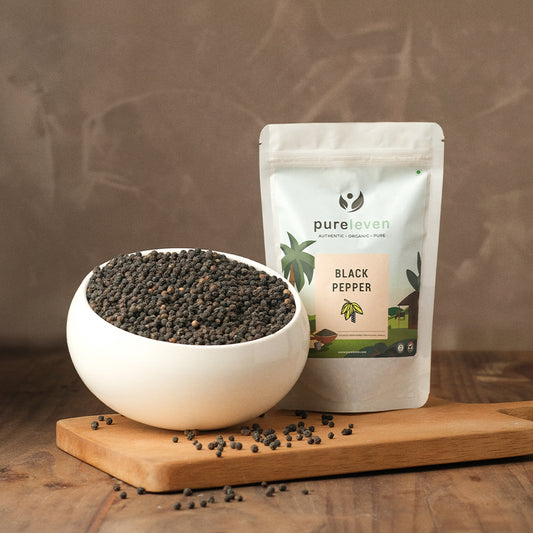 Also considerKerala Black Pepper (Kali Mirch) – Bold Whole Peppercorns from IdukkiRs. 100.00
 Kitchen add-onExtra Bold Kerala Cardamom (Elaichi) – 8mm Whole Pods from IdukkiRs. 309.00Rs. 270.00


