Pureleven journal
Cooking & Spices
From Kerala soil to your kitchen.
Kerala pepper guide
Pepper Density Grades: What 500 g/l and 550 g/l Mean
Move from comparison content into bold, kitchen-ready Kerala pepper with a cleaner buying path.
Quick Summary
What black pepper grades like 500 g/l and 550 g/l mean, how they relate to MG1 and Tellicherry grades, and how to check density at home.
Jump through the guide
Go straight to the sections that answer the buying, comparison, or sourcing question you came for.
Pepper grades like 500 g/l and 550 g/l say how many grams of peppercorns fit into one litre. A higher number means heavier, more solid berries, which usually means fewer hollow, immature corns. In the trade, about 500 g/l is treated as a basic grade and 550 g/l or more as a cleaner, better-filled one.
You'll see these numbers on wholesale listings. This is what they mean, and how much they matter at home.
What does g/l mean on black pepper?
Grams per litre, a measure of bulk density. Fill a one-litre container with peppercorns, level it off and weigh it. If it weighs 550 grams, the lot is 550 g/l.
Weight per volume matters because a berry that developed fully is solid inside, while one picked too young dries into a light, hollow shell. Those light berries fill the same space and weigh far less, so a lot with many of them scores lower. It's a quick, cheap way for traders to judge how much real pepper they're paying for.
Which grades go with which numbers?
Standards use different names but the numbers repeat. These are typical trade figures, and exact values change with the buyer and contract.
| Bulk density | Where you'll see it | What it usually signals |
|---|---|---|
| Around 500 g/l | FAQ (fair average quality) grades, and basic export grades | More light berries allowed |
| Around 550 g/l | Cleaner export grades. Indian MG1 is commonly quoted near here | Cleaned pepper with few light berries |
| 570 to 580 g/l and above | "ASTA" and bold grades, Tellicherry bold lots | Dense, well-cleaned, often larger berries |
IPC is the International Pepper Community, a group of pepper-producing countries that publishes grade standards. ASTA is the American Spice Trade Association, whose cleanliness specifications gave "ASTA pepper" its meaning as a clean, dense grade.
Is 550 g/l better than 500 g/l?
Usually, for the same origin and age. More fully formed berries mean more of the oils and piperine that make pepper taste like pepper in every spoonful.
Density leaves out three things.
- Age. A dense lot from three harvests ago can taste flatter than a fresher 500 g/l lot.
- Moisture. Damp pepper weighs more, which is one reason standards cap moisture.
- Aroma. Two lots with the same g/l can smell quite different, depending on variety, region, drying and storage.
Use g/l as a filter. Our Kerala black pepper buyer's guide lists the other checks worth doing.
How do Indian grades fit in?
Indian grades lead with cleaning and size, not density.
- MG1 (Malabar Garbled grade 1) sets tight limits on light berries, foreign matter and moisture. Traders commonly describe it as around 550 g/l, though it's defined by cleanliness, not by that figure.
- Tellicherry grades (TGEB, TGSEB) are sorted by berry size, roughly 4.25 mm and 4.75 mm and up. Big berries tend to be dense, but the sieve sets the grade.
- Ungarbled pepper is cleaned less strictly and allows more light berries.
The size grades are covered in our Malabar vs Tellicherry pepper guide.
How can you check density at home?
A measuring jug and a kitchen scale do the job.
- Take a 250 ml measuring cup and zero the scale with it on.
- Pour peppercorns in gently until just over the top. Don't shake or press.
- Level the top with a flat knife.
- Weigh the pepper.
- Multiply by 4 to get grams per litre. For example, 137 g in 250 ml is about 548 g/l.
It won't match a trade test exactly, since the way you pour changes the result. It's close enough to separate a dense lot from a light one.
The water test
Simpler still. Drop a spoonful of peppercorns into a glass of water. Solid corns sink and light berries float. A few floaters are normal. A thick layer on top means light pepper, whatever the label says.
Does higher density mean hotter pepper?
Not directly. Denser lots have more solid berries, so you get more flavour per spoonful. Heat depends on piperine, variety and freshness, which density can't measure.
Does g/l matter for a home cook?
A little. You aren't buying by the tonne, so a small difference won't change your cooking. What you'll notice is a lot full of light, hollow corns, which grind to a pale, dusty powder with little bite.
Look for pepper that's whole, dark, heavy in the hand and sharp-smelling when cracked. If it passes the water test and the bite test, it's fine.
Our Kerala black pepper is whole peppercorns from Idukki farms where the vines climb shade trees alongside cardamom, packed with nothing added. We don't quote a g/l figure for it, so weigh a cup of it against any other pepper in your kitchen and see.
Sources
Ready to buy?
Related products for this article
Move from reading intent to shopping intent with product cards tied to this topic and a direct route into the wider catalog.
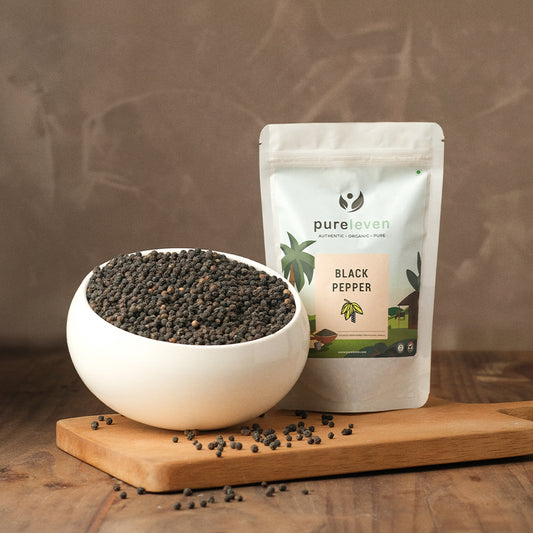 Primary pickKerala Black Pepper (Kali Mirch) – Bold Whole Peppercorns from IdukkiWhole Kerala peppercorns with high aroma and a straightforward upgrade from generic supermarket stock.Rs. 100.00
Also considerKerala Black Pepper (Kali Mirch) – Bold Whole Peppercorns from IdukkiRs. 100.00
 Kitchen add-onKerala White Pepper Whole PeppercornsRs. 184.50Rs. 150.00