



Pureleven journal
Cooking & Spices
From Kerala soil to your kitchen.
Pureleven spice journal
What Does Orange Pekoe Mean? (It's Not Orange)
Answer-first guidance with a faster path to farm-origin Kerala products you can buy today.
Quick Summary
What orange pekoe means as a tea grade, where the name probably came from, and how to read grade letters like FOP and BOP.
Jump through the guide
Go straight to the sections that answer the buying, comparison, or sourcing question you came for.
Orange pekoe (OP) is a tea leaf grade, not a flavour: it describes whole tea leaves of a particular size, and the term is used mainly for black tea. It has nothing to do with oranges, and a higher grade letter tells you about leaf size and appearance, not necessarily how good the tea tastes.
What does orange pekoe actually describe?
In the orthodox tea grading system, orange pekoe is a basic, medium grade made up mostly of whole leaves of a set size. The grading system is used mainly for black teas from India, Sri Lanka and other producing countries outside China.
Grades are given after the tea is made, when the leaf is sorted by size through sieves. So the same garden can produce OP, broken grades and fannings from one batch of leaf.
Where did the name come from?
Nobody knows for sure. The most common explanations:
- "Pekoe" is usually traced to a Chinese (Amoy dialect) word for the fine white down on young tea buds. It appears in an 1819 Chinese dictionary by Robert Morrison as one of the black teas known to Europeans.
- "Orange" has two popular theories. One links it to the Dutch House of Orange-Nassau and Dutch tea traders who wanted to suggest a premium product. The other points to the coppery colour of well-oxidised leaf.
How to read tea grade letters
| Grade | Full name | What it means |
|---|---|---|
| OP | Orange Pekoe | Mostly whole leaves of a set size |
| FOP | Flowery Orange Pekoe | Long leaf with some tips (buds) |
| GFOP / TGFOP | (Tippy) Golden Flowery Orange Pekoe | More golden tips; TGFOP is a main grade for Darjeeling and Assam |
| BOP | Broken Orange Pekoe | Broken leaf pieces; brews stronger and faster; common in South India and Sri Lanka |
| Fannings | Fannings | Small pieces left after larger grades are sorted; used in many tea bags |
| Dust | Dust | The finest particles; brews very fast and dark |
CTC tea, the small round granules most Indian homes use for chai, is made by machine and has its own separate grading system. Our post on CTC vs orthodox tea explains the difference.
Does a higher grade mean better tea?
Not necessarily. Grade tells you about leaf size and how many tips are present. A whole-leaf OP from an average garden can taste flatter than a well-made broken grade from a good one.
It also depends on how you drink tea. For strong milk tea, broken grades and CTC usually work better because they brew faster and darker. Whole-leaf grades show their character best without milk, or with just a little.
How to brew whole-leaf tea
- Use about 1 teaspoon of leaf per 200 ml cup.
- Pour water just off the boil over the leaves.
- Cover and steep for 3 to 5 minutes. Start at 3 and taste.
- Strain completely so the leaves don't keep brewing and turn bitter.
- Taste it plain first, then add milk or sugar if you want.
Common mistakes
- Boiling whole leaves in a pan like chai. It pulls out bitterness. Steep them instead.
- Expecting an orange flavour. Unless something has been added, OP tea tastes of tea.
- Judging tea by grade letters alone. Smell and taste tell you more.
Which of our teas to try
For everyday milk tea, our black tea granules suit the chai method, as in our Kerala chayakada chai recipe. If you'd like to try a leaf tea, see our orange pekoe tea leaves and check the product page for details of that pack.
Sources
Ready to buy?
Related products for this article
Move from reading intent to shopping intent with product cards tied to this topic and a direct route into the wider catalog.
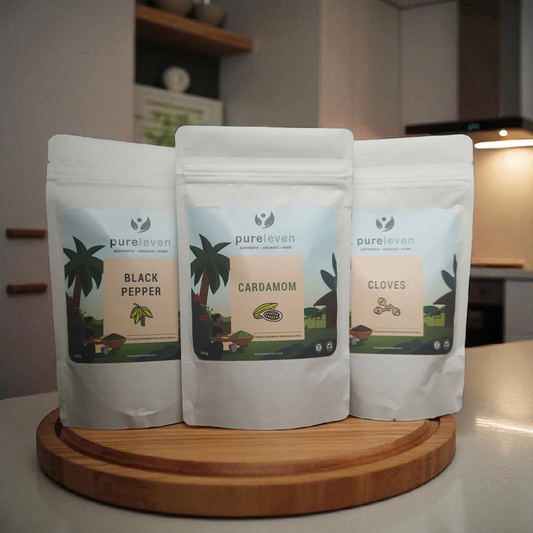 Primary pick3-in-1 Kerala Spice ComboStart with a best-selling Pureleven product picked to match the buying intent behind this article.Rs. 909.00Rs. 559.00
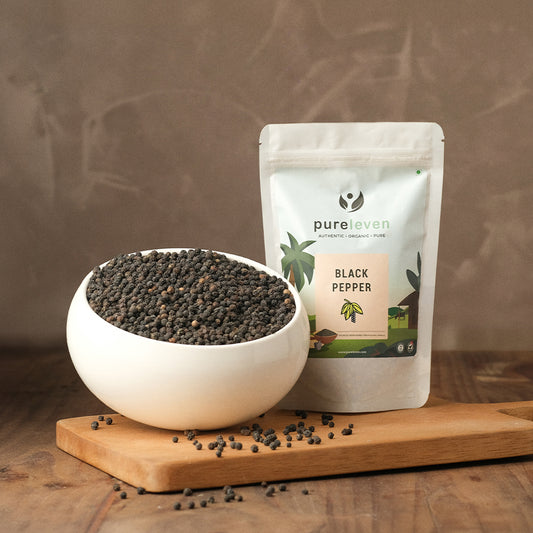 Also considerKerala Black Pepper (Kali Mirch) – Bold Whole Peppercorns from IdukkiRs. 100.00
 Kitchen add-onExtra Bold Kerala Cardamom (Elaichi) – 8mm Whole Pods from IdukkiRs. 309.00Rs. 270.00


