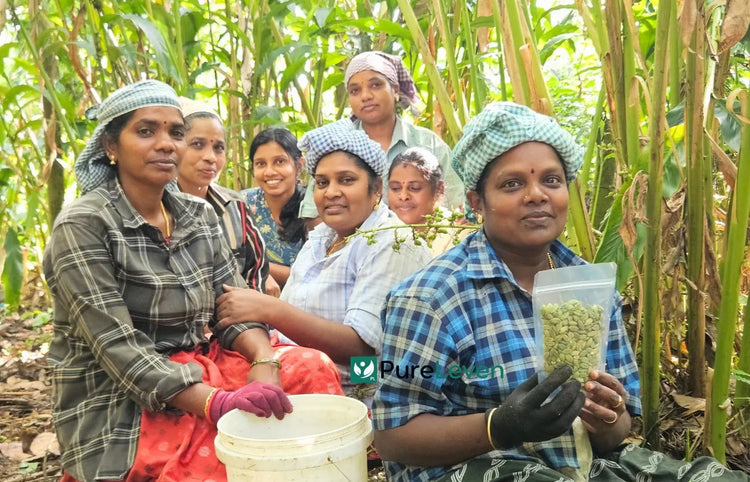
PureLeven cardamom harvest team in Kerala

Kerala cardamom guide

From Black Pepper to Cardamom: How a Rajakumary Farm Changed Its Future

7 min read

Compare pod size, aroma strength, and practical pack sizes before you buy.

Quick Summary

Our farm story: why we switched from black pepper (1 harvest/year) to cardamom/elaichi (3-4 harvests), and how that changed income stability at our Rajakumary farm in Munnar.

1 30 years of farming experience in Kerala
2 Farm-origin sourcing with stronger aroma retention
3 Small-batch packs designed for repeat kitchen use

The Day We Made the Pivot (And Everything Changed)

Our Rajakumary farm in the high ranges of Munnar started out as black pepper.

Rows and rows of pepper vines climbing up trellis after trellis. Dense canopy. Beautiful black berries in winter. One harvest per year—December through January—when the pepper turned red and needed picking, drying, and selling.

Then December came and went. We’d harvest the crop, dry it, store it, and wait 11 months for the next harvest. The cash flow was lumpy. The income was unpredictable. And every November, we’d be stressed about whether that year’s crop would be worth harvesting.

A neighbor asked, “Why not try cardamom?”

That question changed everything. This is our story—and it might help you understand why the cardamom we grow and sell online today is built on years of experience switching from the one-harvest-a-year grind to the three-to-four-harvests-a-year rhythm of cardamom farming.


The Black Pepper Life: One Harvest, 11 Months Waiting

December–January: Harvest Rush. Berries turn red on the vine, the harvest crew picks manually, berries dry in the sun for 4–5 days, then grading, packing, and selling — all revenue compressed into 4–6 weeks.

February–November: The Long Wait. The plants rested. Expenses didn’t: labor, fertilizer and pest control, water management, equipment repairs, living costs. By September, cash was tight most years, spent down from the previous December’s harvest income.

November Anxiety. Every year we’d wonder: will the yield be good? Will prices be decent in December? What if there’s a pest outbreak or the monsoon was bad? One weak harvest year meant financial stress through the entire next year.


Why Black Pepper Farmers Struggle: The Economics

Black pepper economics: 5–6 years to mature, 10–15 year productive lifespan, roughly 1 ton/hectare/year, and a single harvest window in December. All money comes in one month; costs spread across the year. That mismatch is the core stress.


The Cardamom Question: “Why Not Switch?”

We researched cardamom's economics: faster to mature (2–3 years), a longer 15–20 year productive lifespan, and — the game-changer — 3–4 harvests per year (June, August, October, sporadic Dec–May) instead of one. Multiple harvests meant income spread out, not concentrated. But would it work on our land?


The Transition: The Risky Years

We didn’t rip out the pepper overnight. We planted cardamom between the pepper vines, giving the new plants years to mature while pepper still brought in income. Early harvests were tiny — barely a few kilos from young plants — but the plants survived and grew. As yields increased and local buyers wanted what we grew, we slowly converted the remaining pepper vines to cardamom over several years, until the farm was almost entirely cardamom.


The Cardamom Life Today: Cash Flow Throughout the Year

June–July, First Harvest: Immature pods, mixed quality, modest prices — local sales, chai blending, wholesale.

August–September, Second Harvest (PEAK): Optimal ripeness, best quality (AGEB + fruit-seed), highest volume of the year. This is our biggest revenue month despite lower per-kg pricing — direct-to-consumer online sales, export, premium packing.

October–November, Third Harvest: Late-season quality remains excellent as supply tightens and prices climb — premium retail, gifting, subscription boxes.

December–May, Sporadic + Storage Sales: Lower yields, highest prices, premium and online direct-to-consumer sales from stored cardamom.

Compared to the old pepper model — all revenue concentrated into a single December–January window — cardamom spreads income across the year and, taken together across harvests, generates more consistent income overall.


What Changed in Our Lives

Cash flow: Before, the December payout had to last a full year. Now, cash arrives every 6–8 weeks from different harvests — we stopped borrowing before November and can invest in equipment upgrades without panic.

Risk reduction: Before, one bad December was a crisis. Now, one mediocre June is fine because August compensates, and a weak August is cushioned by October.

Family life: Steady income means steady planning — school fees on time, no emergency loans for medical costs, and room to actually plan bigger expenses.

Farming identity: We went from “black pepper commodity farmers” with no differentiation to “cardamom specialists from Rajakumary” — people who handpick, grade, and know every plant. Online customers now ask for “Rajakumary cardamom” by name and come back.


The August Peak: Why This Month Matters to Us Personally

August is our most important month. It's the single biggest revenue month of the year, funding equipment maintenance, fertilizer for all three harvests, and a buffer for slower periods. Third harvest timing (Aug–Sept) also naturally produces our best cardamom — optimal ripeness, no rushing, ideal grading conditions — which is when we make the premium handpicked fruit-seed grade that sells online. August is proof the switch was right.


What It Takes to Grow Premium Cardamom (Rajakumary Style)

People often ask why every farm doesn’t grow cardamom if it's this good. The answer: it's finicky and demands care.

Elevation matters. Rajakumary sits at 1,200–1,600m in the Munnar high ranges — cool temperatures, high monsoon rainfall, consistent humidity, and lower natural pest pressure. Below roughly 800m, cardamom fights heat stress and disease and simply isn't worth it.

Water management. Cardamom needs consistent moisture without waterlogging. Monsoon provides this naturally in Rajakumary; in dry months we run drip irrigation and rely on intercropped shade from areca nut and coconut to retain moisture. Skip this and you get sun-scalded pods and smaller plants.

Sunlight. Full sun damages cardamom — pods scald, seeds shrivel, aroma diminishes. We maintain 30–40% canopy shade from areca and coconut for filtered, dappled light.

Soil health. We use composted farm waste, avoid chemical pesticides in favor of natural pest management, rotate legume crops for nitrogen fixation, and test soil regularly to keep pH in the 5.5–6.5 range cardamom prefers.

Pest and disease watch. Leaf blotch, pod borers, thrips, and root rot are the recurring threats. We manage them with weekly manual inspection during monsoon, traps and bio-pesticides, pruning affected branches, and careful drainage — labor-intensive, but essential for premium grade.


Why We Sell Cardamom Online Now (And What Changed)

For years after switching, we sold entirely through local wholesale buyers, spice traders, and a regional distributor — low margin, no direct feedback, and buyers who never knew our farm existed. Middlemen took a significant cut.

Export disruptions in recent years squeezed the middlemen model further, so we started selling direct. Now we can tell our story — the Rajakumary farm, the switch from pepper, the handpicking, the August peak — and build repeat customers instead of anonymous bulk sales.

When you buy cardamom directly from farmers like us online, you're buying from a farm that switched crops for stability, handles harvest through packing ourselves, handpicks for quality, and knows its customers. That's the difference between “cardamom from somewhere” and Rajakumary cardamom from our farm in Munnar.


What We'd Tell Another Farmer Considering the Switch

1. It takes years to fully transition. Plant cardamom alongside your current crop rather than ripping everything out at once.
2. Elevation matters critically. Below roughly 800m, cardamom won't thrive — stay with pepper or another crop.
3. The August harvest is your lifeline. That's when yields, quality, and revenue prove the switch was worth it.
4. Handpicking is worth the labor cost. Removing empty pods lets you charge a real premium over commodity pricing.
5. Sell online if you can. Direct customers pay fairly; middlemen will always offer less.


Your Part in This Story

When you choose cardamom from a farm like Rajakumary instead of anonymous bulk commodity cardamom, you're supporting a farmer who moved from a risky single annual harvest to a stable multi-harvest model, a farm that invests in quality because direct customers matter, and sustainable farming at elevation rather than chemical-heavy lowland commodity production.

Questions? This is a real farm with a real story. Email hello@pureleven.com and ask about our current harvest — we'll reply.


Ready to Taste the Difference?

You now understand why we switched from black pepper to cardamom, how multiple harvests a year changed our farm economics, why August is our most important month, and what it takes to grow premium cardamom in Munnar.

👉 Shop Rajakumary Cardamom — farm-direct, handpicked, August harvest available
👉 Get in Touch — harvest updates directly from the farm
👉 Read the Full Process — behind-the-scenes from planting to packaging


This is our story. It's embedded in every pod.

—The Rajakumary team

Ready to buy?

Related products for this article

Move from reading intent to shopping intent with product cards tied to this topic and a direct route into the wider catalog.

Kerala Cardamom Whole Pods Primary pickKerala Cardamom Whole PodsExport-grade Kerala cardamom with strong aroma for chai, desserts, and everyday cooking.Rs. 299.00Rs. 260.00 Shop this cardamom Kerala Cardamom Whole Pods Also considerKerala Cardamom Whole PodsRs. 299.00Rs. 260.00 View product Kerala Cardamom Whole Pods Kitchen add-onKerala Cardamom Whole PodsRs. 299.00Rs. 260.00 View product
Shop Kerala cardamom See all products

Suggested reads

Keep exploring this topic

Move from this guide into adjacent reads from the same journal, then jump back into the catalog when you are ready to buy.

PureLeven cardamom product pack, farm-direct

Farm-Direct Cardamom Online vs Retail: Price, Q...

Why farm-direct cardamom (elaichi) beats middlemen: verified market data shows 8.5mm grade commands a 35% premium and prices have risen 46% in two years. Here's how to buy smart.

Farm-Direct Cardamom Online vs Retail: Price, Q...

Why farm-direct cardamom (elaichi) beats middlemen: verified market data shows 8.5mm grade commands a 35% premium and prices have risen 46% in two years. Here's how to buy smart.

Cardamom plant with growing pods in Kerala

Cardamom Cultivation Guide: How to Grow Premium...

A complete cardamom (elaichi) farming guide: elevation requirements, water and shade balance, soil prep, natural pest control, and the real economics of growing cardamom.

Cardamom Cultivation Guide: How to Grow Premium...

A complete cardamom (elaichi) farming guide: elevation requirements, water and shade balance, soil prep, natural pest control, and the real economics of growing cardamom.

Hand holding freshly picked green cardamom pods

Cardamom Harvest & Handpicking: From Plant to Y...

The 8-phase journey from flower to harvest: why handpicking removes most pods to keep only the best cardamom (elaichi), and how to spot full-seed pods versus hollow ones.

Cardamom Harvest & Handpicking: From Plant to Y...

The 8-phase journey from flower to harvest: why handpicking removes most pods to keep only the best cardamom (elaichi), and how to spot full-seed pods versus hollow ones.

Shop Kerala cardamom See all Cooking & Spices
Back to blog

Shop the article product

Kerala Cardamom Whole Pods
Shop this cardamom

Explore Pureleven Kerala spices

1 of 4
  • 30 years farming experience

    Kerala-rooted farming knowledge shapes the sourcing, grading, and packing decisions behind every Pureleven product.

  • Sustainable cultivation

    Farm-origin sourcing and long-term cultivation practices help protect soil health, flavor quality, and future harvests.

  • Aroma-first small batches

    Small-batch processing and cleaner packaging keep more aroma in the pouch and more flavor in the kitchen.

  • Kerala-origin quality

    Readers move from educational content into traceable Kerala staples rather than anonymous marketplace inventory.

From Kerala soil to your kitchen.

Ready to move from reading to buying?

Use the guide as a decision surface, then move directly into collections, bundles, and the wider Pureleven catalog without losing shopping momentum.