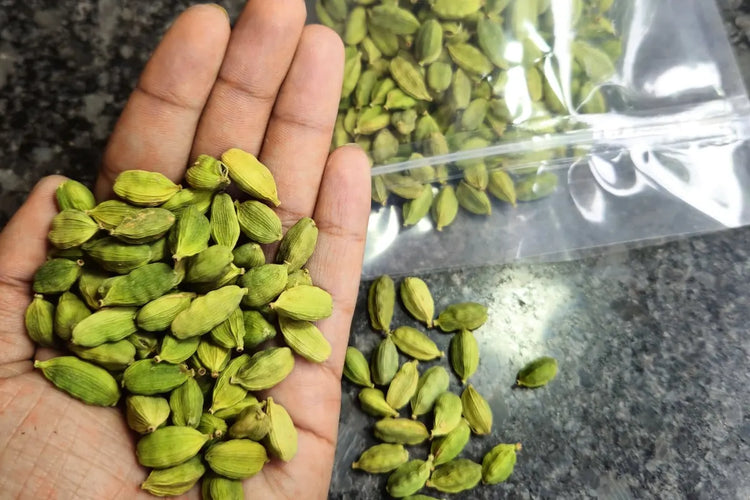
Hand holding freshly picked green cardamom pods

Kerala cardamom guide

Cardamom Harvest & Handpicking: From Plant to Your Cup (Complete Process)

6 min read

Compare pod size, aroma strength, and practical pack sizes before you buy.

Quick Summary

The 8-phase journey from flower to harvest: why handpicking removes most pods to keep only the best cardamom (elaichi), and how to spot full-seed pods versus hollow ones.

1 30 years of farming experience in Kerala
2 Farm-origin sourcing with stronger aroma retention
3 Small-batch packs designed for repeat kitchen use

The Journey of a Single Pod: From Plant to Premium Grade

A perfect cardamom pod in your tea didn’t just happen.

From the moment a cardamom flower appears on the plant to the second you crack it open over your chai, that pod goes through several distinct phases. Each phase determines whether it ends up as premium fruit-seed grade or gets discarded during handpicking.

This is the complete story—the decisions, the labor, the quality gates—that separate the cardamom you buy online from commodity bulk cardamom.


Phase 1: Flowering & Pod Formation

On our Rajakumary farm, cardamom plants start flowering in April–May. Small white/pink flowers emerge near ground level, bloom for 2–3 weeks, get pollinated, then fade as tiny green pods begin forming where the flowers were.

Flower health at this stage determines seed potential later: water stress during flowering means a weaker fruit set, pest or disease pressure means damaged pods later, and optimal conditions now mean higher seed fill at harvest.


Phase 2: Pod Development & Growth

The newly formed pod grows over several months. Early on it's tiny, bright green, and tightly closed with soft immature seeds inside. Over subsequent months it swells, seeds firm up and darken, and by full maturity the pod shows clear ripeness indicators: color shifting from bright green to olive or brownish-green, seams splitting slightly, and a noticeable aroma when handled.

Throughout this window farmers watch mist and humidity (too dry means small seeds and hollow pods; too wet means mold risk), sunlight exposure (direct sun causes scald; proper shade improves seed fill), and pest pressure. Pods that experience stress during this phase end up with fewer seeds or hollow chambers even once they mature.


Phase 3: Harvest Decision — Timing Is Everything

Too early (immature): pod is green but seeds are still soft and whitish — this becomes Pinchu grade, bitter with weak aroma.
Perfect (optimal ripeness): pod is olive-green with plump dark-brown seeds and slightly split seams — this becomes AGEB or Fruit-seed grade.
Too late (over-ripe): pod has dried on the plant and seeds start shrinking — this becomes Muthath grade, acceptable but not premium.

Experienced pickers read ripeness by pod color, how tightly the seams are sealed, pod weight, and aroma. First harvest (June–July) happens during monsoon pressure, so farmers often pick slightly early to beat fungal rot — which is why that harvest skews toward lower grades. Second harvest (August–September) hits the optimal window: late monsoon plus early dry conditions let farmers wait for full ripeness, producing the best grade distribution of the year.


Phase 4: Harvesting (Manual Picking, Not Machine)

Cardamom is harvested entirely by hand because every pod ripens at a slightly different time — a machine would pick immature, mature, and over-ripe pods all together. During peak season our harvest crew walks the rows every 2–3 days, gently picks only ripe pods, and leaves immature ones for the next pass.

This takes real skill: an inexperienced picker can grab immature pods that still look green, damage the plant while picking, or miss half-ripe pods. Labor is a significant share of harvest cost for exactly this reason — it's also why cheap cardamom often comes from farms that skip careful hand-selection to save on labor.


Phase 5: Drying (The Aroma & Color Lock-In)

After harvest, fresh green pods are dried down to roughly 8–10% moisture over about a week: a couple of days of gentle indirect sun to start wilting, several more days of fuller sun exposure while the outer pod dries and color deepens to olive-green, then final drying (partly indoors) until seeds rattle slightly — a sign moisture is right and aroma is locked in.

Some farms use mechanical dryers for speed, but that comes with aroma loss and inconsistent seed retention from heat damage. We stick with slower sun-drying because it preserves aroma better. Pods showing mold or defects during this stage get pulled before moving on to sorting.


Phase 6: Sorting by Size

After drying, pods are sorted by length into size bins (6–7mm, 7–8mm, 8–9mm, 9mm+) since buyers grade by pod size. Cracked, broken, or severely discolored pods get removed here, but this stage still doesn't check what's inside — some hollow pods slip through size sorting alone.


Phase 7: Handpicking — The Premium Quality Gate

This is where premium cardamom is made. Handpicking is the phase that separates fruit-seed grade from commodity cardamom — not sieving or mechanical sorting, but human hands and eyes doing quality-focused selection.

Staff open and inspect a sample of each batch to check seed fill and aroma, then visually grade the rest by appearance: smooth uniform green pods likely have full seeds, while discolored or shriveled ones likely have empties or defects. Any pod with cracks, discoloration, unusual smallness, visible mold, or damage gets removed. Typically, only a modest fraction of a harvest survives this level of scrutiny for the top fruit-seed tier — the rest gets sorted into AGEB or Karinkka grade for wholesale.

This is why handpicked cardamom costs more: a large share of the harvest is deliberately set aside so what remains is consistently full-seed.


Phase 8: Final Grading & Packaging

Handpicked pods go through a final check — confirming pod size, spot-checking seed fill, an aroma test, color uniformity, and a weight check (full-seed pods are noticeably heavier). Packaging is labeled with grade, harvest date, and pack date, and a small sample from each batch is kept back for ongoing quality monitoring.


Why Some Cardamom Arrives Empty (The Handpicking Reality)

Why is my cardamom pod empty inside?” is one of the most common complaints from online buyers. The usual causes: immature harvest (pod picked before seeds filled), over-ripe or fallen pods (seeds dried out and shrank), storage or shipping damage, or simply no handpicking at all — bulk cardamom sold without human inspection lets empty pods slip through.

To avoid this: look for sellers who explicitly mention handpicking, ask directly whether empty pods get removed, check reviews for mentions of “full pods” or “full seeds,” and crack open a couple of pods yourself on arrival.


Why Handpicking Matters (The Economics)

Handpicked premium cardamom costs more because of the labor at every stage — careful hand-harvesting, slow sun-drying, and the sorting/handpicking step where a large share of the batch gets set aside for lower grades. Cheap cardamom skips this: machine harvest, fast drying, no handpicking. It costs less to produce, but the tradeoff shows up as empty pods and weaker aroma.


What to Look for When Buying: Handpicking Signals

Good signs: “handpicked,” a specific grade and pod size (not just “premium”), an explicit seed-fill mention, and a harvest date. Weak signs: vague “best quality” claims, “bulk discount” pricing, or no mention of grading or handpicking at all.


The Payoff: When You Crack Open a Premium Pod

Handpicked, farm-direct cardamom opens easily, seeds fill most of the pod with no hollow chambers, the aroma is immediate and strong, seeds are dark brown and plump, there's zero bitterness in chai, and the aroma holds up over months of storage. That's the difference between “okay cardamom” and cardamom that actually surprises you.


Ready to Experience Premium Harvest?

You now understand the journey from flower to cup, why the August harvest window is optimal, what handpicking actually removes and why, and how to spot handpicked cardamom when shopping.

👉 Shop Handpicked Cardamom — August harvest, 8.5mm fruit-seed, hand-inspected for full pods
👉 Ask Us About This Season's Harvest
👉 Subscribe for Fresh Harvest Alerts


Questions? Email hello@pureleven.com — we're happy to share more about our handpicking process.

Next read: Cardamom Cultivation Guide

Ready to buy?

Related products for this article

Move from reading intent to shopping intent with product cards tied to this topic and a direct route into the wider catalog.

Kerala Cardamom Whole Pods Primary pickKerala Cardamom Whole PodsExport-grade Kerala cardamom with strong aroma for chai, desserts, and everyday cooking.Rs. 299.00Rs. 260.00 Shop this cardamom Kerala Cardamom Whole Pods Also considerKerala Cardamom Whole PodsRs. 299.00Rs. 260.00 View product Kerala Cardamom Whole Pods Kitchen add-onKerala Cardamom Whole PodsRs. 299.00Rs. 260.00 View product
Shop Kerala cardamom See all products

Suggested reads

Keep exploring this topic

Move from this guide into adjacent reads from the same journal, then jump back into the catalog when you are ready to buy.

PureLeven cardamom product pack, farm-direct

Farm-Direct Cardamom Online vs Retail: Price, Q...

Why farm-direct cardamom (elaichi) beats middlemen: verified market data shows 8.5mm grade commands a 35% premium and prices have risen 46% in two years. Here's how to buy smart.

Farm-Direct Cardamom Online vs Retail: Price, Q...

Why farm-direct cardamom (elaichi) beats middlemen: verified market data shows 8.5mm grade commands a 35% premium and prices have risen 46% in two years. Here's how to buy smart.

Cardamom plant with growing pods in Kerala

Cardamom Cultivation Guide: How to Grow Premium...

A complete cardamom (elaichi) farming guide: elevation requirements, water and shade balance, soil prep, natural pest control, and the real economics of growing cardamom.

Cardamom Cultivation Guide: How to Grow Premium...

A complete cardamom (elaichi) farming guide: elevation requirements, water and shade balance, soil prep, natural pest control, and the real economics of growing cardamom.

PureLeven cardamom harvest team in Kerala

From Black Pepper to Cardamom: How a Rajakumary...

Our farm story: why we switched from black pepper (1 harvest/year) to cardamom/elaichi (3-4 harvests), and how that changed income stability at our Rajakumary farm in Munnar.

From Black Pepper to Cardamom: How a Rajakumary...

Our farm story: why we switched from black pepper (1 harvest/year) to cardamom/elaichi (3-4 harvests), and how that changed income stability at our Rajakumary farm in Munnar.

Shop Kerala cardamom See all Cooking & Spices
Back to blog

Shop the article product

Kerala Cardamom Whole Pods
Shop this cardamom

Explore Pureleven Kerala spices

1 of 4
  • 30 years farming experience

    Kerala-rooted farming knowledge shapes the sourcing, grading, and packing decisions behind every Pureleven product.

  • Sustainable cultivation

    Farm-origin sourcing and long-term cultivation practices help protect soil health, flavor quality, and future harvests.

  • Aroma-first small batches

    Small-batch processing and cleaner packaging keep more aroma in the pouch and more flavor in the kitchen.

  • Kerala-origin quality

    Readers move from educational content into traceable Kerala staples rather than anonymous marketplace inventory.

From Kerala soil to your kitchen.

Ready to move from reading to buying?

Use the guide as a decision surface, then move directly into collections, bundles, and the wider Pureleven catalog without losing shopping momentum.