Kerala cardamom guide
Cardamom Cultivation Guide: How to Grow Premium Cardamom (Elevation, Water, Soil)
Compare pod size, aroma strength, and practical pack sizes before you buy.
Quick Summary
A complete cardamom (elaichi) farming guide: elevation requirements, water and shade balance, soil prep, natural pest control, and the real economics of growing cardamom.
Jump through the guide
Go straight to the sections that answer the buying, comparison, or sourcing question you came for.
The Short Truth: Cardamom Is Delicate (But Worth It)
Cardamom farming looks beautiful from the outside: lush green plants, aromatic pods, many pickings a year. But cardamom is finicky and demands consistent care. Get the climate, soil, water and shade wrong, and you'll end up with small pods, hollow seeds and weak aroma. Get it right, and you'll harvest full, bold, fragrant cardamom.
This guide covers elevation, water, shade, soil, natural fertiliser and pest management, the conditions behind the cardamom grown around Rajakumari.
Location and Elevation
In Kerala, small cardamom is mostly grown in the hills, commonly somewhere around 600 to 1,500 metres. Elevation brings cooler, steadier temperatures, monsoon mist, high humidity and airflow that helps prevent fungal disease.
At low elevations, cardamom faces heat stress and higher disease risk. It can be grown there, but it needs much more irrigation, shade and care, and yields are usually lower than on good hill land.
Climate and Monsoon Cycles
Cardamom farming is inseparable from the monsoon. Cardamom areas in Kerala typically receive heavy rainfall, concentrated between June and September. The monsoon brings mist and steady moisture; the months after bring clear skies for ripening.
Long dry spells mean stressed plants and poorly filled pods. Very prolonged, heavy rain brings fungal disease and root rot. Monsoon timing also drives flowering, which is why a weak or late monsoon can affect the whole season's crop.
Water Management: Moist, Never Waterlogged
This is the single biggest challenge in cardamom cultivation: consistent moisture without ever waterlogging the roots.
In natural high-range conditions like Rajakumari, monsoon rain, shade and leaf-litter mulch handle much of this. In drier months, or at lower elevation, growers typically need drip or sprinkler irrigation, heavy mulching and good drainage.
Too dry shows up as curling yellow leaves, shrivelled pods and hollow seeds. Too wet shows up as root rot, fungal disease and stunted growth. The target: soil that feels moist but never soggy.
Shade: The Goldilocks Zone
Cardamom is naturally a shade-loving plant of the forest understorey. It needs filtered light: too much direct sun scalds pods, shrivels seeds and damages aroma; too much shade weakens flowering and seed fill and invites fungal problems.
In Idukki, cardamom is traditionally grown under the canopy of taller shade trees, which are thinned or pruned to let in the right amount of light. Shade nets are a workable but more artificial alternative.
Soil: The Foundation of Great Cardamom
Cardamom wants loamy, well-draining forest soil rich in organic matter, slightly acidic (roughly pH 5.0 to 6.5), with a deep root zone. It does poorly in heavy clay (waterlogging, root rot), sandy soil (drought stress, nutrient leaching), alkaline soil or compacted ground.
Before planting, test soil pH and organic matter, add composted organic matter, and improve drainage where needed. Ongoing, cardamom benefits from regular compost and mulching. Neem cake is often used as a natural pest deterrent.
Pest and Disease Management
Cardamom pests are manageable with early action. Common problems include thrips, shoot and capsule borers, and fungal diseases such as capsule rot (azhukal) and root rot, which get worse in heavy monsoon humidity. For specific control measures, the Spices Board and Kerala's agricultural research stations publish up-to-date recommendations.
The general approach: scout regularly during the monsoon, remove affected plant material quickly, keep good airflow and drainage, and avoid replanting cardamom repeatedly in the same diseased patch.
The Growing Cycle
Cardamom is usually planted at the start of the monsoon and spends its first year establishing roots. The first small harvests typically come in years 2 to 3. Production builds over the next few years, stays strong for a good number of years with proper care, and then gradually declines, when replanting decisions start to matter.
How Cardamom Is Grown Around Rajakumari
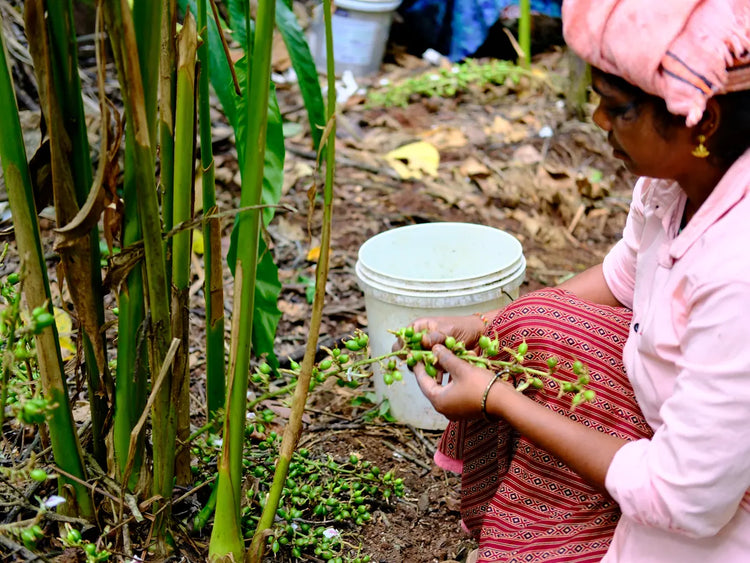
Farms in our part of the high ranges rely on shade trees, monsoon rain supplemented by irrigation in the driest months, compost and mulching, regular scouting for pests, and selective hand-picking that leaves immature pods for the next round. You can read more about how our own farm got here in From Black Pepper to Cardamom.
If You Want to Grow Cardamom at Home
Realistic expectations: one or two plants in large pots, a first harvest after a few years, and modest yield per plant. You'll need a large well-draining pot, a rich, coir-based potting mix, filtered light and consistent moisture. Cardamom does best in humid, frost-free places.
Cardamom Isn't a Get-Rich-Quick Crop
It's a long-term crop with a multi-year horizon, and it spreads income across several pickings rather than one harvest. It is not a low-labour crop, and prices swing a lot from year to year with weather and market conditions.
Ready to Grow or Buy Cardamom?
If you want to grow: start with one or two plants and scale only if that goes well. If you want to buy: look for sellers who can tell you where and when their cardamom was grown.
Questions about growing cardamom? Email purelevenexim@gmail.com or message us on WhatsApp at +91 88482 65849.
Next read: How cardamom is harvested by hand
Ready to buy?
Related products for this article
Move from reading intent to shopping intent with product cards tied to this topic and a direct route into the wider catalog.
 Primary pickExtra Bold Kerala Cardamom (Elaichi) – 8mm Whole Pods from IdukkiExport-grade Kerala cardamom with strong aroma for chai, desserts, and everyday cooking.Rs. 309.00Rs. 270.00
Also considerExtra Bold Kerala Cardamom (Elaichi) – 8mm Whole Pods from IdukkiRs. 309.00Rs. 270.00
Kitchen add-onExtra Bold Kerala Cardamom (Elaichi) – 8mm Whole Pods from IdukkiRs. 309.00Rs. 270.00
Primary pickExtra Bold Kerala Cardamom (Elaichi) – 8mm Whole Pods from IdukkiExport-grade Kerala cardamom with strong aroma for chai, desserts, and everyday cooking.Rs. 309.00Rs. 270.00
Also considerExtra Bold Kerala Cardamom (Elaichi) – 8mm Whole Pods from IdukkiRs. 309.00Rs. 270.00
Kitchen add-onExtra Bold Kerala Cardamom (Elaichi) – 8mm Whole Pods from IdukkiRs. 309.00Rs. 270.00