Pureleven journal
Cooking & Spices
From Kerala soil to your kitchen.
Kerala pepper guide
Piperine: Why Black Pepper Tastes Hot
Move from comparison content into bold, kitchen-ready Kerala pepper with a cleaner buying path.
Quick Summary
What piperine is, how it makes black pepper taste hot, roughly how much pepper contains, and why light and grinding make pepper lose its bite.
Jump through the guide
Go straight to the sections that answer the buying, comparison, or sourcing question you came for.
Piperine is the natural compound that makes black pepper taste hot. It switches on the same heat receptor in your mouth that chilli does, only far more gently than capsaicin. Black pepper holds a few percent piperine by weight, and the exact amount depends on the variety, the growing conditions and how fresh the pepper is.
That covers the basics. The rest explains why freshly cracked pepper bites harder than old powder, and why a jar on a sunny windowsill goes flat.
What is piperine?
An alkaloid, from a family of plant compounds that also includes caffeine. It was first isolated from pepper in 1819 by the Danish scientist Hans Christian Ørsted, better known for his work on electromagnetism.
It sits mostly in the outer layers and flesh of the peppercorn. Pure piperine is a pale yellow crystalline powder with almost no smell. The smell of pepper comes from a separate set of compounds, the volatile oils, covered below.
Why does pepper taste hot?
Your mouth has heat-sensing receptors called TRPV1, which normally fire when something is physically hot. Some compounds can trigger them too, and your brain reads the signal as burning.
Capsaicin from chillies is the famous one. Piperine does the same job much more gently. Estimates put it at roughly a hundredth of capsaicin's heat, so a big spoonful of pepper makes you cough but never builds the long, rising burn of a green chilli.
Pepper heat also arrives fast, sits at the front and back of the mouth and fades quickly. Chilli heat lingers.
Heat and aroma come from different compounds
A peppercorn has two flavour systems working together.
| Piperine | Volatile oils | |
|---|---|---|
| What it gives | Heat and bite | Aroma: woody, citrusy, piney, floral |
| Main compounds | Piperine and related alkaloids | Terpenes such as pinene, limonene and caryophyllene |
| How it's lost | Slowly, mainly through light | Quickly, by evaporating once ground |
| What you notice | Old pepper still has some heat | Old pepper smells of very little |
That's why stale ground pepper can still make you sneeze and yet smell of dust. Some heat survives. The aroma doesn't.
How much piperine does black pepper contain?
Published figures range from about 2 percent to around 9 percent by weight. Variety, region, harvest and the way it was measured all move the number, so any single figure is a rough guide.
- Variety. Some Kerala cultivars are known for stronger pungency. Our Kerala pepper varieties post has more.
- Maturity. Berries picked well before they fill out carry less of everything, including piperine. That's one reason traders watch density grades like 550 g/l.
- Processing. White pepper loses its outer skin, which shifts the balance between heat and aroma. Our white pepper guide explains why it tastes sharper and earthier.
We don't quote a piperine figure for our own pepper. Crack a corn and judge for yourself.
Why does pepper lose its bite in light?
Piperine is sensitive to light, especially ultraviolet. Exposed, it slowly changes into related forms, such as chavicine and isopiperine, that taste of very little. The pepper hasn't gone bad. It has just weakened.
Ground pepper suffers most because every grain is exposed, and a glass shaker by a sunny window can go flat within weeks.
- Buy whole peppercorns and grind small amounts.
- Use an opaque jar, or keep the jar in a closed cupboard.
- Keep it away from the stove, where heat and steam speed up losses.
More in how to store spices.
What about piperine and absorption?
Piperine is often mentioned alongside turmeric. Researchers have studied how it affects the absorption of some other compounds, curcumin being the best known. It's an active research area, and lab and small human studies don't turn straight into everyday advice.
In food amounts, pepper is a spice. Concentrated piperine supplements are different, since piperine can change how the body handles some medicines. If you're thinking of taking a piperine or pepper extract supplement, ask your doctor first.
Why does pepper make you sneeze?
Fine pepper dust reaches the nose, where piperine irritates nerve endings in the lining, and the body sneezes to clear it. Coarsely cracked pepper makes far less dust than fine powder.
Our pepper
Our Kerala black pepper is whole peppercorns from Idukki farms where the vines climb shade trees alongside cardamom, packed with nothing added. Keeping it whole is the easiest way to protect both heat and aroma until you need them. For choosing pepper in general, see our Kerala black pepper buyer's guide.
Crack one fresh peppercorn, smell it, then taste it. The smell comes first and the heat follows a second later.
Sources
Ready to buy?
Related products for this article
Move from reading intent to shopping intent with product cards tied to this topic and a direct route into the wider catalog.
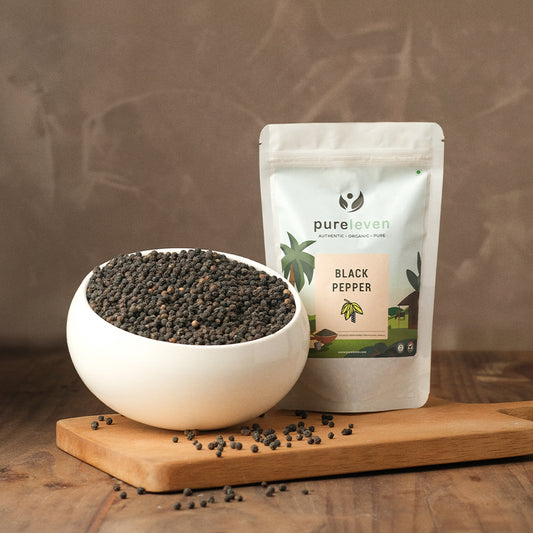 Primary pickKerala Black Pepper (Kali Mirch) – Bold Whole Peppercorns from IdukkiWhole Kerala peppercorns with high aroma and a straightforward upgrade from generic supermarket stock.Rs. 100.00
Also considerKerala Black Pepper (Kali Mirch) – Bold Whole Peppercorns from IdukkiRs. 100.00
 Kitchen add-onKerala White Pepper Whole PeppercornsRs. 184.50Rs. 150.00