Pureleven journal
Cooking & Spices
From Kerala soil to your kitchen.
Kerala cardamom guide
The Cardamom Hills of Idukki: A Short History
Compare pod size, aroma strength, and practical pack sizes before you buy.
Quick Summary
A short history of Idukki's Cardamom Hills, from wild forest cardamom to Travancore's rules, the Cardamom Hill Reserve and today's family farms.
Jump through the guide
Go straight to the sections that answer the buying, comparison, or sourcing question you came for.
The history of Idukki's Cardamom Hills goes back a long way. Cardamom grew wild in these Western Ghats forests long before anyone planted it. Farming it in an organised way came later, through Travancore's cardamom rules in 1822, the Cardamom Hill Reserve of 1897, and the settlers who cleared small plots in the high ranges during the 20th century.
This post tells that story, from forest spice to the farms we work with today.
Where exactly are the Cardamom Hills?
The Cardamom Hills are the stretch of the Western Ghats running through Idukki district, along the border between Kerala and Tamil Nadu. The crest of the hills more or less is the state border. Anamudi, the highest peak in India south of the Himalayas at about 2,695 metres, sits at the northern end.
Most cardamom here grows at middle altitudes, roughly 600 to 1,200 metres, under the shade of taller trees. That shade matters, and it's the reason the hills look like forest even where they're full of farms.
Did cardamom grow here before anyone farmed it?
Yes. Green cardamom (Elettaria cardamomum, or elakka in Malayalam) is native to the forests of the Western Ghats in south India. For centuries it was gathered from the wild understorey rather than planted in rows.
Pepper has an even older reputation. Portuguese traders in the 16th century called this part of the hills "the pepper country", and pepper from the Malabar coast had been shipped west since Roman times. Cardamom travelled on the same routes.
What did the kingdom of Travancore do?
Most of today's Idukki was part of Travancore. In 1822, a royal proclamation on cardamom created revenue officers whose job was to promote cardamom growing and protect the farmers. It also brought in Tamil workers from the neighbouring Madras Presidency to harvest cardamom in the hills.
Cardamom was valuable, and the state wanted control of the trade. That early link with Tamil workers and traders is why so much of the cardamom business still crosses the border today. Bodinayakanur, just over the hills in Tamil Nadu, is still one of the two cardamom auction centres.
The Cardamom Hill Reserve (1897)
In 1897, another Travancore proclamation set up the Cardamom Hill Reserve, or CHR. The idea was simple: keep the forest trees standing and lease the land under them for cardamom. Farmers could grow cardamom but not clear the canopy.
Today the CHR covers roughly 1,070 square kilometres, and about half of that is leased to farmers for cardamom. The CHR area is commonly estimated to produce around 70 percent of India's cardamom. It's the reason Idukki cardamom is still mostly shade-grown.
When did the farms we know today appear?
Tea came first on a big scale. In 1877, the Kannan Devan hills near Munnar were leased for tea estates, and many Tamil workers moved up to work on them.
The small family farms came mostly in the 1940s and after. Families from central Kerala moved into the high ranges and cleared land for food crops, then for cardamom, pepper, coffee and later rubber. Many of the towns in Idukki (Kumily, Kattappana, Rajakumari and others) grew out of these settlements.
Idukki became its own district on 26 January 1972, carved out of the high range taluks of old Kottayam district plus Thodupuzha.
Why is it called "Alleppey Green" if it grows in Idukki?
This confuses a lot of people. Alleppey (Alappuzha) is on the coast, nowhere near the hills. The name comes from the old trade: cardamom from the hills was carried down to Alleppey, processed and shipped from there. The name stuck to the spice, not the place it grew.
Alleppey Green Cardamom was registered as a Geographical Indication around 2007 to 2008. So when you see that name on a pack, the cardamom most likely grew in the Cardamom Hills.
A quick timeline
| When | What happened |
|---|---|
| Ancient times | Wild cardamom gathered from Western Ghats forests; pepper traded from the Malabar coast |
| 16th century | Portuguese traders call the area "the pepper country" |
| 1822 | Travancore's cardamom proclamation creates officers to promote cardamom growing |
| 1877 | Kannan Devan hills near Munnar leased for tea |
| 1897 | Cardamom Hill Reserve set up, keeping the forest canopy |
| 1940s onwards | Settler families start small farms in the high ranges |
| 1972 | Idukki district formed |
| 1978 | Indian Cardamom Research Institute opens at Myladumpara, Idukki |
| 2007 | Spices Board moves cardamom auctions to an electronic system at Puttady and Bodinayakanur |
What does this history mean for the cardamom you buy?
Two things carried over from the old rules. First, cardamom in Idukki is still grown under trees, not in open fields. Second, most of it is grown by families on small plots, not by a few big companies.
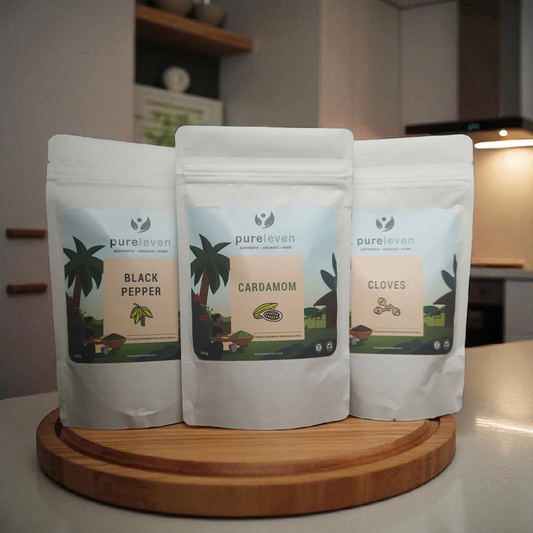
Our own family has farmed in Rajakumari for about 30 years, starting with pepper and moving into cardamom. There's a longer post on how our farm went from black pepper to cardamom. We now work with a small group of farming families around Idukki, dry the cardamom in a cardamom dryer, and pack it whole with nothing added, in resealable pouches. You can see it here: Kerala cardamom, whole pods from Idukki.
For a wider look at what grows in the district and how to buy it, start with our guide to Idukki spices online.
Next time you crack open a pod, you'll know it comes from forest that's been protected for well over a century.
Sources
Ready to buy?
Related products for this article
Move from reading intent to shopping intent with product cards tied to this topic and a direct route into the wider catalog.
 Primary pickExtra Bold Kerala Cardamom (Elaichi) – 8mm Whole Pods from IdukkiExport-grade Kerala cardamom with strong aroma for chai, desserts, and everyday cooking.Rs. 309.00Rs. 270.00
Also considerExtra Bold Kerala Cardamom (Elaichi) – 8mm Whole Pods from IdukkiRs. 309.00Rs. 270.00
Kitchen add-onExtra Bold Kerala Cardamom (Elaichi) – 8mm Whole Pods from IdukkiRs. 309.00Rs. 270.00
Primary pickExtra Bold Kerala Cardamom (Elaichi) – 8mm Whole Pods from IdukkiExport-grade Kerala cardamom with strong aroma for chai, desserts, and everyday cooking.Rs. 309.00Rs. 270.00
Also considerExtra Bold Kerala Cardamom (Elaichi) – 8mm Whole Pods from IdukkiRs. 309.00Rs. 270.00
Kitchen add-onExtra Bold Kerala Cardamom (Elaichi) – 8mm Whole Pods from IdukkiRs. 309.00Rs. 270.00